
Mortgage rates are unlikely to return to their pre-pandemic lows anytime soon. The average 30-year fixed mortgage rate stood at 7.24% on October 29, 2026, compared with 6.17% a year earlier, according to Freddie Mac. The persistence of high borrowing costs is not simply a consequence of Federal Reserve policy. Inflation, rising energy prices, expanding federal debt, and changing bond-market expectations are collectively creating an environment in which long-term interest rates could remain elevated.
For the housing market, the implications extend beyond monthly mortgage payments. High financing costs are weakening purchasing power, restricting homeowner mobility, and slowing transactions, even as more properties become available for sale.
Why Aren't Mortgage Rates Falling?
The first distinction is between the federal funds rate and mortgage rates. The Federal Reserve influences short-term borrowing costs, but 30-year mortgage rates are more closely linked to the 10-year Treasury yield and the additional compensation investors demand for holding mortgage-backed securities.
Long-term Treasury yields reflect expectations about future short-term interest rates, inflation, economic growth, and the term premium, which is the additional return investors require for holding longer-duration debt. Consequently, even if the Federal Reserve lowers short-term interest rates, mortgage rates may decline only modestly if inflation expectations or Treasury yields remain elevated.
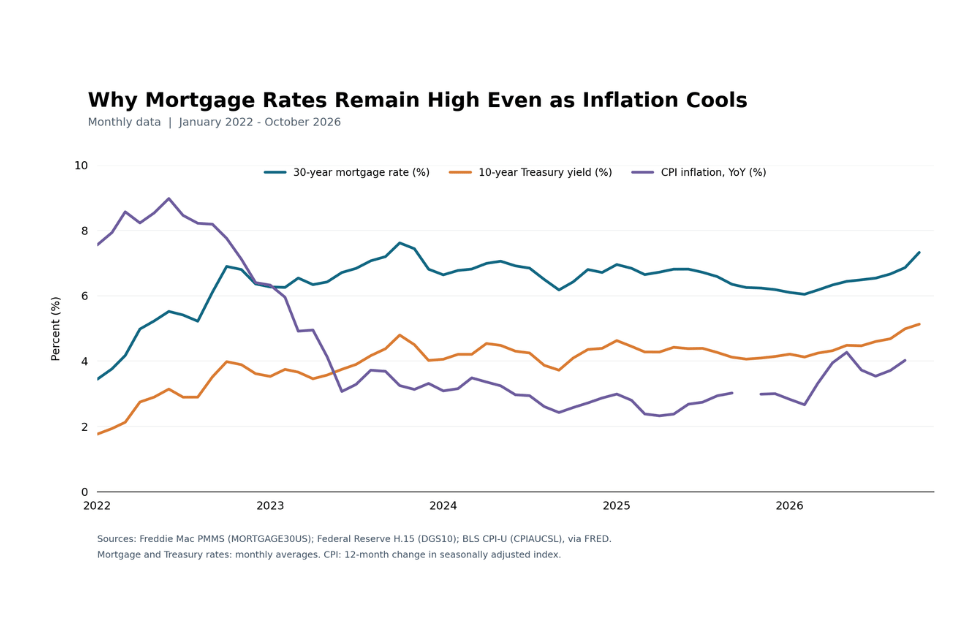
The chart above shows that mortgage rates and 10-year Treasury yields generally move together, while CPI inflation follows a different trajectory. Despite inflation retreating from its 2022 peak, mortgage rates have remained elevated, reflecting their closer relationship with long-term Treasury yields and broader financial market conditions.
Inflation Is Proving Difficult to Contain
Inflation continues to complicate the outlook for lower mortgage rates. Consumer prices rose 3.7% over the 12 months ending September 2026, up from 3.4% in August, according to the Bureau of Labor Statistics. Renewed inflationary pressures could limit the Federal Reserve’s ability to reduce short-term interest rates while keeping inflation expectations and long-term Treasury yields elevated. Because mortgage rates are closely tied to Treasury yields, persistent inflation could delay meaningful relief for homebuyers.
Persistent inflation affects mortgage rates through two channels. It reduces the likelihood of aggressive Federal Reserve easing and raises the inflation compensation investors require on long-term bonds.
The critical variable is not simply whether inflation declines, but whether investors believe it will remain contained. A sustained improvement in inflation expectations would support lower Treasury yields. Repeated price shocks would have the opposite effect.
Oil Prices Are Adding Another Inflation Risk
Energy markets have become an important source of uncertainty. In its October 2026 Commodity Markets Outlook, the World Bank projected a 32% increase in energy prices during 2026, with Brent crude averaging $91 per barrel, up from $69 in 2025. The forecast reflects supply disruptions and geopolitical instability in the Middle East.
Higher oil prices affect far more than gasoline. They increase transportation, agricultural, manufacturing, and distribution costs, potentially feeding into a broader range of consumer prices. An oil shock also presents a monetary policy dilemma. Rising oil prices present a challenge for the Federal Reserve. Higher energy costs increase inflation while leaving households with less money to spend on other goods and services. Although the Fed cannot directly control oil prices, it must prevent these increases from spreading into broader inflation. This could lead the Fed to keep interest rates elevated for longer, even as economic growth slows.
For mortgage markets, this uncertainty can keep longer-term borrowing costs elevated even when economic growth weakens.
America's Growing Debt Is Putting Pressure on Long-Term Rates
Persistent federal deficits and growing government borrowing could add upward pressure to Treasury yields, making it harder for mortgage rates to decline. The Congressional Budget Office projects a $1.9 trillion federal deficit in fiscal year 2026, equivalent to 5.8% of GDP. Federal debt held by the public is projected to rise from 101% of GDP in 2026 to 120% by 2036.
Persistent deficits require substantial Treasury issuance. All else equal, greater bond supply can place upward pressure on yields, particularly when investors demand higher returns to absorb additional long-term debt. However, Treasury yields also depend on domestic and international demand, economic expectations, and the perceived safety of U.S. government securities. Nevertheless, sustained borrowing creates a potential obstacle to materially lower long-term interest rates.
What Do Persistently High Mortgage Rates Mean for Housing?
The affordability consequences are substantial. On a $400,000 mortgage, the monthly principal and interest payment at 7.24% is approximately $2,730, compared with $2,440 at 6.17%. That difference amounts to roughly $290 per month, or $3,480 annually, before property taxes, insurance, and maintenance.
Higher financing costs reduce the mortgage amount households can qualify for and constrain their ability to purchase homes.
Many existing homeowners hold mortgages at rates substantially below current market levels. Selling means surrendering that financing advantage, creating a financial incentive to remain in place. This mortgage-rate lock-in effect restricts housing turnover and can limit the supply of existing homes.
The result is a market characterized by weak transaction volumes rather than necessarily widespread price declines.
Regional outcomes will differ. Markets with greater available supply and more price-sensitive demand may experience larger price adjustments. Areas with limited housing availability and relatively stable employment may prove more resistant.
What Would Bring Mortgage Rates Down?
A sustained decline would likely require several developments: inflation moving convincingly toward the Federal Reserve’s target, easing energy price pressures, stable inflation expectations, and lower long-term Treasury yields. Reduced mortgage-backed securities spreads could provide additional relief.
A significant economic slowdown could also push rates lower as investors seek safer assets and anticipate monetary easing. But that would not necessarily translate into a housing recovery if unemployment rises and household confidence deteriorates.
Homebuyers hoping for a significant drop in mortgage rates may face a prolonged wait. Inflationary pressures, growing federal debt, and elevated Treasury yields could keep borrowing costs high, even if the Federal Reserve lowers short-term interest rates. Veros forecasts that the 30-year fixed mortgage rate will remain near 7.2% by the third quarter of 2027, suggesting that homebuyers are unlikely to see substantial relief in borrowing costs over the next year.
For housing, the consequence is a prolonged affordability adjustment. Without meaningful relief from mortgage rates, home prices, or household incomes, transaction activity is likely to remain constrained, with local supply conditions determining how much of the adjustment occurs through prices rather than sales volumes.