
Economic Indicators
Indicators that provide signals about the current state and future direction of the economy and the housing market.
30-yr Fixed Rate Mortgage
| SEP. 2025 | SEP. 2026 | DEC. 2026 FORECAST |
|---|---|---|
| 6.4% | 6.9% | 6.9% |
30-yr FRM: Freddie Mac®, Forecast: Veros
Unemployment Rate
| SEP. 2025 | SEP. 2026 | DEC. 2026 FORECAST |
|---|---|---|
| 4.5% | 4.2% | 4.0% |
Unemployment rate: Bureau of Labor Statistics, Forecast: Veros
Inflation Rate
| SEP. 2025 | SEP. 2026 | DEC. 2026 FORECAST |
|---|---|---|
| 3.0% | 3.7% | 3.4% |
Inflation: Bureau of Labor Statistics, Forecast: Veros
Hourly Earnings
| SEP. 2025 | SEP. 2026 |
|---|---|
| $36.70 | $37.81 |
Source: Bureau of Labor Statistics
Housing Inventory
| SEP. 2025 | SEP. 2026 |
|---|---|
| 1.53 Million | 1.60 Million |
Source: National Association of Realtors
Housing Starts
| AUG. 2025 | AUG. 2026 |
|---|---|
| 1.291 Million | 1.275 Million |
Source: Census.gov
Housing Market Hotness Index
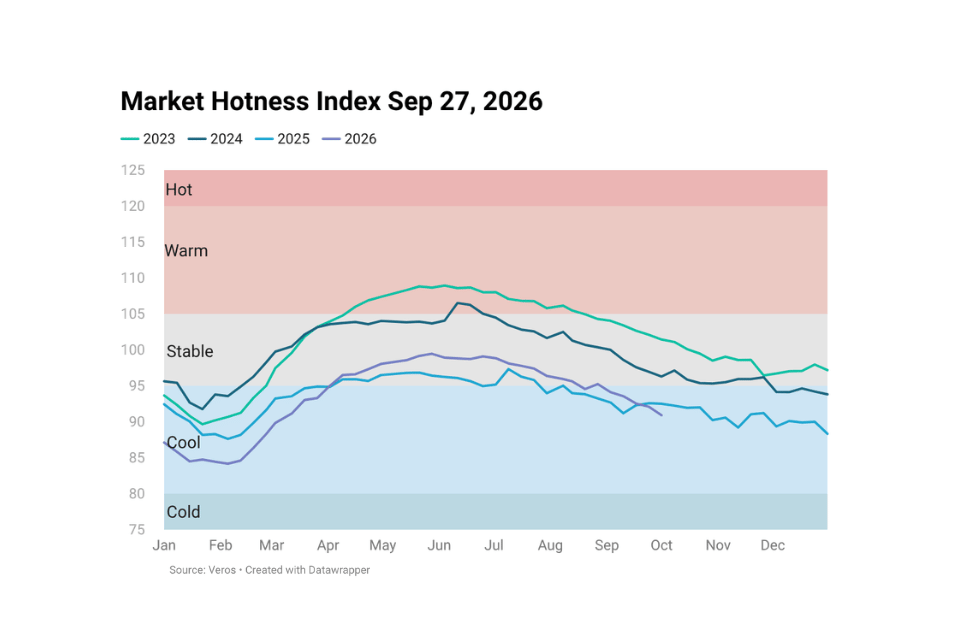
Discover housing market trends with the Market Hotness Index, a weekly metric utilizing proprietary data on housing activity, demand, and supply indicators across the top 100 U.S. counties.
- The Market Hotness Index is formulated through a combination of proprietary data pertaining to housing activity and demand and supply indicators for the 100 most populous counties in the U.S.
- The index is scheduled to be disseminated weekly and serves as a metric to identify markets gaining momentum or waning. A market exhibiting a score in the 95-105 range on this index is considered a stable market, with a score surpassing this range implying a hotter market, and a score below 95 indicating a cooling market.
Mortgage Rates Are Above 7%, But Some Markets Are Still Hot
The U.S. Housing Market Hotness Index fell to 90.11 for the week ending September 27, 2026, as mortgage rates above 7% put renewed pressure on affordability and housing demand. Beneath the national slowdown, however, significant regional differences remain, with many Northeast and Midwest markets outperforming cooler markets across Texas and the Sun Belt.
Read More →
Has the U.S. Housing Market Already Peaked in 2026?
The U.S. Housing Market Hotness Index fell for a sixth consecutive week as elevated mortgage rates and rising homeownership costs continued to challenge affordability. National conditions remain subdued, but substantial differences in buyer demand are emerging across local housing markets.
High Mortgage Rates Continue to Cool the U.S. Housing Market
The U.S. Housing Market Hotness Index declined for the fifth consecutive week as elevated mortgage rates and affordability challenges continued to slow buyer demand and pending home sales. While the national housing market remains subdued, local market performance continues to diverge, with some counties showing resilience and others experiencing noticeably weaker housing activity.
Housing Market Cools as Mortgage Rates Approach 7%
The U.S. Housing Market Hotness Index fell to 92.54 for the week ending September 13, 2026, moving further into cool territory as mortgage rates climbed and affordability deteriorated. While national conditions softened, substantial differences across counties show that housing demand remains highly dependent on local supply, affordability, and economic conditions.
U.S. Housing Market Slows as Local Markets Continue to Diverge
The U.S. Housing Market Hotness Index fell for the fourth consecutive week as high mortgage rates, affordability challenges, and economic uncertainty continued to slow buyer demand. While the national market remains soft, local housing markets are following very different paths.
Why Is the Housing Market Still Stuck as Summer Ends?
The U.S. Housing Market Hotness Index edged up to 95.24 for the week ending August 23, 2026, but elevated mortgage rates, high home prices, inflation, and economic uncertainty continue to constrain housing demand. Beneath the subdued national market, significant regional differences remain, with some counties showing stronger buyer demand while markets in parts of Florida, Texas, and Tennessee continue to lag.