
For anyone waiting for mortgage rates to return to the levels that prevailed in 2020-2022, the housing market has delivered another unwelcome reminder: borrowing costs can move in the wrong direction quickly. The average 30-year fixed mortgage rate reached 7.28% on October 1, according to Freddie Mac, up from 6.66% just five weeks earlier. A year ago, it stood at 6.34%.
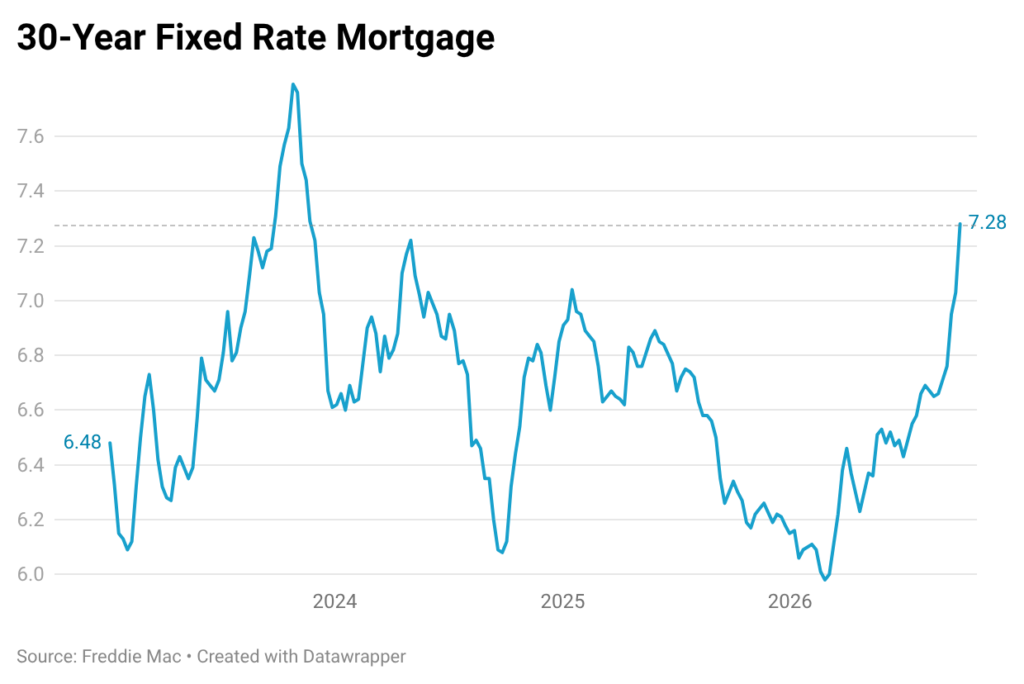
But what does another period of mortgage rates above 7% mean for the housing market?
The answer is more complicated than “buyers can’t afford homes.” Mortgage rates affect how much buyers can borrow, whether homeowners are willing to sell, how many transactions occur, what builders do and, eventually, how home prices behave.
A One-Point Rate Increase Costs More Than It Sounds
Consider a buyer borrowing $400,000 with a 30-year fixed-rate mortgage. At 6%, principal and interest are approximately $2,398 per month. At 7%, that rises to approximately $2,661. At 7.28%, it reaches roughly $2,738. Going from 6% to 7.28% adds about $340 every month, or more than $4,000 a year, without the buyer purchasing a larger or better home.
The effect can also be viewed through purchasing power. A household able to devote $2,400 per month to principal and interest could finance roughly $400,000 at 6%. At 7.28%, that same payment finances only about $351,000. That is approximately $49,000 less borrowing capacity solely because the interest rate changed.
And that calculation excludes property taxes, homeowners’ insurance, HOA fees, maintenance and other costs of ownership.
Why Don't Buyers Simply Purchase Cheaper Homes?
Some do. But the housing market cannot instantly reprice every home to offset an increase in financing costs.
Suppose a buyer purchasing a $500,000 home with 20% down sees the mortgage rate increase from 6% to 7.28%. For the monthly principal-and-interest payment to remain approximately unchanged, the purchase price would need to fall to roughly $439,000, assuming the same 20% down-payment percentage. That is a decline of about 12%.
National home prices generally do not reset by that magnitude simply because rates rise.
Instead, households adjust in other ways. Some buy smaller homes. Some move farther from employment centers. Some increase their down payment. Some delay buying. And some leave the market entirely.
That is one reason transaction volume can respond much faster than home prices.
The Latest Sales Numbers Are Already Showing the Strain
Existing-home sales fell 2.0% in August to a seasonally adjusted annual rate of 3.98 million, according to NAR. Sales were also 1.2% below their year-earlier level.
Meanwhile, inventory reached 1.62 million homes, 5.9% above August 2025 and the first reading above 1.6 million since November 2019. Months’ supply increased to 4.9. Those numbers point to a market in which buyers have gained choices while transactions remain constrained.
Yet prices haven’t collapsed. The median existing home price was $429,100 in August, 1.6% higher than a year earlier. FHFA’s repeat-sales index similarly showed U.S. house prices increasing 2.6% from July 2025 to July 2026.
Why?
High Mortgage Rates Hit Housing Supply Too
This is one of the most important and often overlooked features of today’s housing market. Millions of homeowners financed their properties when mortgage rates were substantially lower. Moving can mean giving up that mortgage and financing the next home at today’s much higher rate.
Federal Reserve researchers have documented the consequences of this mortgage-rate lock-in effect. Their research estimates that lock-in accounted for 44% of the decline in mortgage-borrower mobility from 2021 to 2022.
Higher mortgage rates reduce demand because purchasing becomes more expensive. But they can simultaneously reduce supply because existing homeowners become less willing to move. Normally, sharply weaker demand would put substantial downward pressure on prices. When supply contracts alongside demand, the price response can be smaller. In other words, high mortgage rates can freeze the housing market rather than simply crash it.
Why 7% Doesn't Mean the Same Thing Everywhere
The national mortgage rate also meets radically different local housing markets. FHFA’s latest data show national house prices up 2.6% over the past year, but Census-division appreciation ranged from just 0.6% in the Mountain division to 6.3% in the Middle Atlantic.
The same 7.28% mortgage rate applies whether a buyer is looking in a relatively affordable Midwest market or a coastal market where home prices can represent many multiples of household income. That means the rate is national, but the affordability shock is local.
A market with lower prices relative to incomes has more capacity to absorb higher financing costs. A market already stretched to its affordability limit has considerably less. Inventory, employment, migration, construction and household wealth further alter the response.
What Would Actually Cause Home Prices to Fall?
Mortgage rates alone aren’t the entire answer. For broad home-price declines to develop, high financing costs generally need to interact with something else: enough homes available for sale relative to demand, weaker household finances, deteriorating labor-market conditions, forced selling, or some combination of these forces.
So what happens if mortgage rates stay above 7%?
The longer rates remain elevated, the more pressure accumulates. Buyer purchasing power falls. Transactions remain weak. Homes compete for a smaller buyer pool. Sellers who must move become more willing to negotiate. And markets with abundant inventory become more vulnerable to price declines.
But today’s housing market also contains an important stabilizer: many homeowners don’t have to sell. That creates a tug-of-war between affordability on the demand side and homeowner staying power on the supply side. So, the most important question may not be whether mortgage rates briefly cross 7%. It is how long they stay there and what happens in the broader economy.