For the past several years, one question has dominated conversations among homebuyers, sellers, and investors: Will home prices finally fall?
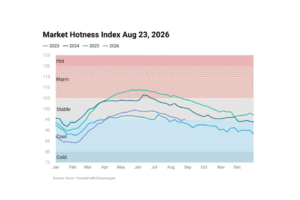
Buyers hoping for lower home prices continue to face one of the most challenging housing markets in decades. According to Freddie Mac, the average 30-year fixed mortgage rate recently climbed to 6.58%, nearly the highest level in a year. At the same time, the National Association of REALTORS® reported that the median existing-home price reached a record $440,600 in June 2026, marking the 36th consecutive month of year-over-year price increases despite sluggish home sales. Existing-home sales remain subdued at an annualized pace of 4.09 million, well below the historical norm of roughly 5.2 million. Yet despite weaker demand, national home prices have remained remarkably resilient.
So, is a nationwide decline finally on the horizon?
According to nearly every major housing forecast, the answer is probably not.
Why Haven't Home Prices Fallen?
Historically, home prices weaken when demand falls faster than supply. Today’s housing market is different because both demand and supply have contracted.
High mortgage rates have sidelined many prospective buyers, but they have also discouraged existing homeowners from selling. Millions of homeowners continue to hold mortgages with interest rates well below current market levels, creating the well-known “lock-in effect.” Rather than giving up a 3% mortgage for one above 6%, many owners are choosing to stay put.
The result is a market with fewer buyers, but also far fewer homes available for purchase.
Although inventory has improved from the record lows seen during the pandemic, it remains below long-term norms in many markets, particularly across the Northeast and Midwest. Limited supply has continued to place a floor under home prices even as sales activity has slowed.
What Do Forecasts Predict?
While forecasts differ by organization, there is broad agreement that national home prices are expected to grow modestly rather than decline sharply.
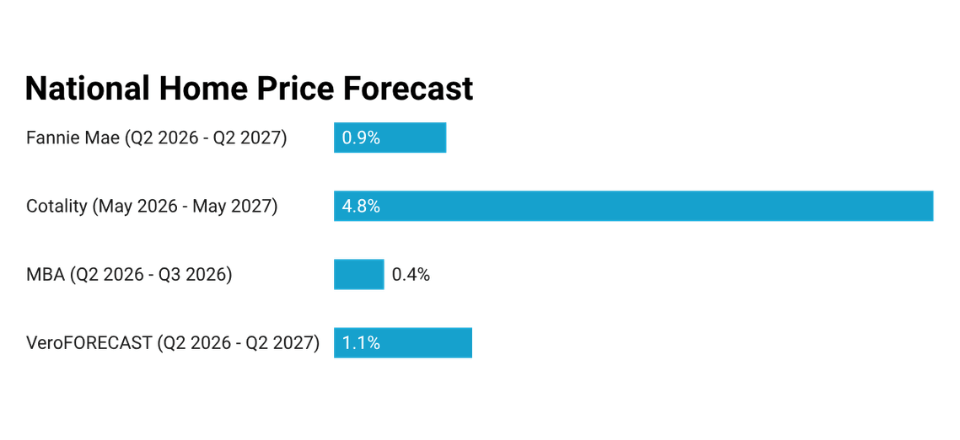
Although the exact forecasts vary, the message is remarkably consistent: most are projecting slower appreciation, not a nationwide price collapse.
Could Prices Still Decline?
Absolutely, but any declines are likely to be localized rather than national.
Markets that experienced exceptionally rapid appreciation during the pandemic have generally seen the greatest slowdown. Areas with substantial new construction, higher investor activity, or weaker population growth are more vulnerable to price declines.
Conversely, markets with limited inventory, constrained new construction, and stable employment continue to demonstrate resilience despite elevated mortgage rates.
What Could Change the Outlook?
Several factors could alter the trajectory of home prices over the next year.
If mortgage rates decline meaningfully, affordability would improve, likely bringing more buyers back into the market. However, lower rates could also encourage additional sellers to list their homes, increasing inventory. The balance between these forces will largely determine whether prices accelerate or remain subdued.
Economic conditions will also play an important role. Labor market strength, consumer confidence, inflation, and wage growth all influence housing demand. While uncertainty remains elevated, most economists do not anticipate the type of widespread distress selling that characterized the 2008 housing downturn.
The Bottom Line
For buyers hoping for a nationwide collapse in home prices, current forecasts suggest that outcome remains unlikely. Instead, most major organizations expect national home prices to remain relatively stable or post modest gains over the coming year.
The bigger story is not whether U.S. home prices will fall, it is where they may fall. As housing conditions become increasingly local, buyers and sellers should pay less attention to national headlines and more attention to the fundamentals driving their own market.