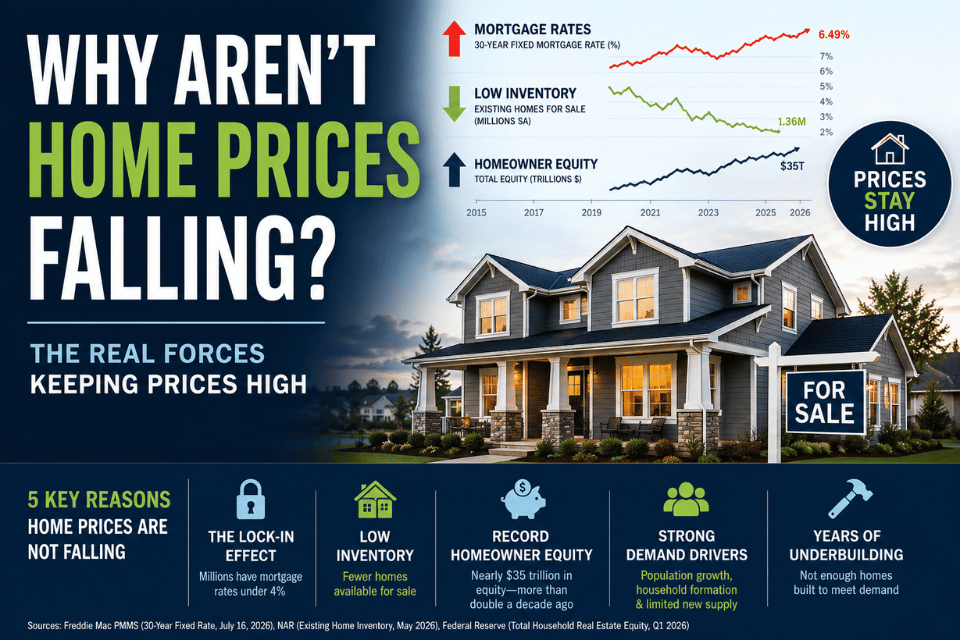
Why are home prices still high despite elevated mortgage rates and slower home sales? For years, many homebuyers have been waiting for prices to come down. Mortgage rates have more than doubled from the record lows seen during the pandemic. Freddie Mac’s 30-year fixed mortgage averaged 2.65% in January 2021, compared with approximately 6.5% in July 2026, dramatically increasing monthly mortgage payments for today’s buyers. Meanwhile, existing home sales remain roughly 25% below the pre-pandemic average (National Association of Realtors), reflecting the strain higher borrowing costs have placed on affordability. According to the Harvard Joint Center for Housing Studies, a household now needs an annual income of approximately $127,000 to afford the median-priced U.S. home, yet only about 6 million of the nation’s 46 million renter households meet that threshold. Under normal market conditions, these factors would be expected to put significant downward pressure on home prices. Yet, despite weaker demand, home prices in many parts of the country continue to remain remarkably resilient.
The relationship between buyer demand and home sales can be seen in Veros’ Housing Market Hotness Index. The index measures the strength of housing market activity by combining key demand and supply indicators into a single measure of market momentum. As the chart illustrates, movements in the Housing Market Hotness Index closely track monthly existing home sales.
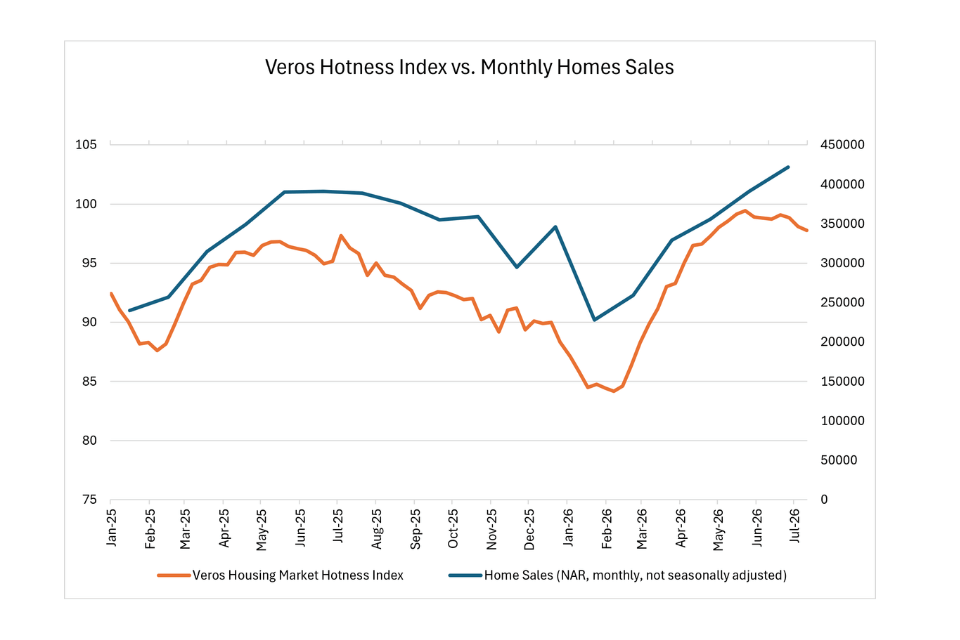
So why aren’t home prices falling?
The answer lies in a housing market unlike any we have experienced before. Today’s market is shaped by a unique combination of limited inventory, record homeowner equity, demographic trends, and homeowner behavior that has fundamentally changed how the housing market responds to higher mortgage rates.
Housing Demand Has Weakened, But So Has Housing Supply
Higher mortgage rates have unquestionably reduced demand. As borrowing costs increased, monthly mortgage payments rose dramatically, pricing many first-time buyers and move-up buyers out of the market.
Normally, falling demand would lead to declining home prices. However, today’s market has experienced an equally important decline in supply.
Nearly 30% of all homeowners currently have mortgage rates below 3%, and roughly 40% own their homes free and clear. Selling their current home often means purchasing another property financed at an interest rate nearly double what they currently pay.
This “lock-in effect” has become one of the defining characteristics of today’s housing market. Instead of listing their homes for sale, many homeowners simply remain where they are, keeping inventory historically constrained.
Inventory Remains Low
Although inventory has improved modestly from the record lows reached during the pandemic, the National Association of Realtors reported approximately 1.36 million existing homes available for sale in spring 2026, well below the inventory levels typically seen before 2020. The United States has spent more than a decade underbuilding homes relative to population growth, leaving the market with a structural housing shortage.
New construction has helped add supply, particularly in parts of the South and Mountain West, but builders continue to face challenges including higher financing costs, labor shortages, land constraints, and elevated construction costs.
As long as the number of homes available for sale remains limited, prices are likely to remain supported even if buyer demand is softer than normal.
Homeowners Are Not Under Financial Pressure to Sell
After years of home price appreciation, U.S. homeowners collectively hold nearly $35 trillion in home equity; this is more than double the level recorded a decade ago. This unprecedented wealth cushion means relatively few homeowners are forced to sell into a declining market. Many have accumulated substantial wealth through rising home values while also benefiting from fixed-rate mortgages with historically low interest rates.
Because most homeowners have strong equity positions, they are generally under little pressure to accept significantly lower offers. Rather than selling at a discount, many simply choose to delay moving until market conditions become more favorable.
Sellers Are Adjusting Expectations—Not Necessarily Prices
One common misconception is that sellers refuse to lower their asking prices. In reality, many sellers are making adjustments, but they are often smaller than buyers expect.
Price reductions have become more common in markets where inventory has increased rapidly, particularly in portions of Florida, Texas, Arizona, and other Sun Belt markets that experienced exceptionally strong appreciation during the pandemic. However, these reductions often represent negotiations from ambitious listing prices rather than broad declines in overall home values.
In many markets, sellers have become more willing to offer concessions such as mortgage rate buydowns, closing cost assistance, or repair credits instead of making substantial price cuts. These incentives reduce buyers’ effective costs while allowing sellers to preserve headline sale prices.
Home Prices are Local
Although national headlines often refer to “the housing market,” there is no single U.S. housing market. Veros’ VeroFORECAST® continues to project meaningful differences across metropolitan areas, with some markets expected to appreciate while others experience modest price declines.
Local conditions vary considerably depending on employment growth, population trends, housing supply, affordability, and new construction activity.
Some markets continue to experience strong demand because of limited inventory and healthy local economies. Others, particularly markets that saw rapid price appreciation and significant new construction, have experienced softer demand and more frequent price reductions.
Could Home Prices Still Decline?
Home prices are not guaranteed to keep rising.
Markets with rapidly increasing inventory, slowing population growth, or weakening local economies could experience price declines. Similarly, if mortgage rates remain elevated for an extended period or unemployment rises meaningfully, additional downward pressure on prices could emerge.
However, absent a significant increase in housing supply or widespread distressed selling, a broad national decline similar to the one experienced during the Great Recession appears less likely.