The question many prospective buyers are asking right now is simple: Is it safe to buy a home?
It’s also one of the most searched housing-related questions online, and for good reasons. The housing market in 2026 is being shaped by a mix of elevated mortgage rates, affordability challenges, and broader economic uncertainty. While conditions are not as extreme as in recent years, they are far from straightforward.
The answer depends less on timing the market and more on understanding the forces currently shaping it.
Mortgage Rates Are Lower—But Still Elevated
Mortgage rates, one of the most immediate drivers of affordability, have declined modestly and are currently hovering in the range of 6.2% to 6.4%. This represents a drop of roughly 50 to 60 basis points compared to the same time last year.
But context matters.
While that reduction provides some relief, it has not been enough to significantly improve affordability. Rates remain well above the historically low levels seen during the pandemic, and because housing affordability is driven by monthly payments rather than price alone, borrowing costs continue to limit purchasing power for many households.
Lower rates may improve conditions at the margin, but they have not fundamentally reset affordability.
Home Prices Haven’t Adjusted Much
At the same time, home prices have not meaningfully adjusted downward. According to NAR data, the median existing home price is currently around $408,880 (March 2026), with year-over-year growth flattening to roughly 1.4%. While this slowdown in price appreciation signals stabilization, it does not translate into meaningful affordability gains. Since 2020, home prices have increased by approximately 50%, and that cumulative rise continues to weigh on buyers, even as wage growth has improved modestly.
Housing Activity Remains Subdued
Housing activity further reflects this tension. Existing home sales remain historically weak, with March 2026 sales falling to 3.98 million, down 3.6% from the prior month. Overall activity continues to hover near levels last seen in the aftermath of the 2008 housing crisis. While demand has not disappeared, it is being constrained by affordability and uncertainty, preventing it from translating into transactions.
Supply conditions are improving, but not enough to fully rebalance the market. Inventory has risen to approximately 1.36 million homes, up about 2.3% from a year ago. Similarly, months of supply in March 2026 stands at around 4.1 months, slightly higher than the 4.0 months’ supply a year ago, but still below the 5 to 6 months typically associated with a balanced market. A key reason for this continued tightness is the “lock-in effect,” where homeowners who secured low mortgage rates in prior years are reluctant to sell, limiting the flow of new listings.
Buyers Are Becoming More Selective
Recent housing data reflects a more cautious market. Buyer behavior is shifting. Homes are taking longer to sell, with median days on market increasing to 57 days (March 2026), up from 53 days a year earlier, according to realtor.com data. At the same time, a growing share of transactions involves price reductions, indicating increased price sensitivity among buyers. This reflects a market that is no longer overheated, but one that has not fully transitioned into a buyer’s market either. Buyers are taking more time, comparing options more carefully, and becoming more sensitive to price and financing costs.
Demand hasn’t disappeared, it has become more selective.
The Labor Market Is Stable—But Slowing
The labor market plays a critical role in housing decisions.
While unemployment remains relatively low at 4.3%, hiring has slowed and job growth has moderated compared to previous years. That shift matters because homebuying decisions depend not just on employment, but on confidence in future income.
Even when buyers qualify financially, uncertainty around job stability can delay decisions.
The Market Is Increasingly Local
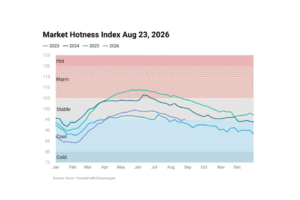
Another defining feature of the current housing landscape is the growing divergence across regions. Markets in the Northeast continue to show relative strength, supported by lower price points and tighter supply. In contrast, parts of the Sun Belt, including sections of Florida and Texas, are experiencing softer conditions, with rising inventory and slower demand. This regional variation underscores a broader shift in the housing market, where local dynamics are increasingly shaping outcomes rather than national trends.
This means there is no single answer to whether it is “safe” to buy, it depends heavily on:
- Local market conditions
- Price levels
- Inventory availability
So, Is It Safe to Buy a Home Right Now?
The data does not point to a single risk that defines the housing market today. There is neither an immediate risk of a sharp downturn, nor of a rapid improvement in affordability or demand. Instead, data points to a market defined by trade-offs. For buyers, the decision is less about timing the market perfectly and more about evaluating personal financial stability, long-term plans, and local market conditions.
Buying a home in 2026 is less about timing the market perfectly and more about navigating these conditions carefully.