For homeowners who locked in low mortgage rates, moving can be expensive. Replacing a low-rate mortgage with one carrying a substantially higher interest rate can increase monthly housing costs considerably. Renovating rather than moving may therefore make more financial sense.
Rising home prices have also allowed many homeowners to accumulate substantial equity, making home equity loans and home equity lines of credit (HELOCs) an attractive source of renovation financing. But the cost of improvements is not necessarily reflected in a home’s market value. Borrowing to renovate can leave homeowners with more debt and less equity, even when their property increases in value.
Which Home Improvements Deliver the Highest Returns?
According to Zonda’s 2025 Cost vs. Value Report, exterior replacement projects accounted for eight of the ten improvements with the highest estimated returns at resale.
Garage door replacement topped the rankings. At an average cost of $4,672, it was estimated to add $12,507 in resale value, recovering approximately 268% of its cost. Steel entry door replacement recovered 216%, while manufactured stone veneer recovered 208%.
These returns contrast sharply with more expensive renovations. A minor kitchen remodel, costing an average of $28,458, was estimated to add $32,141 in resale value, recovering 113%. A major midrange kitchen remodel, however, cost approximately $82,793 and recovered only 51%.
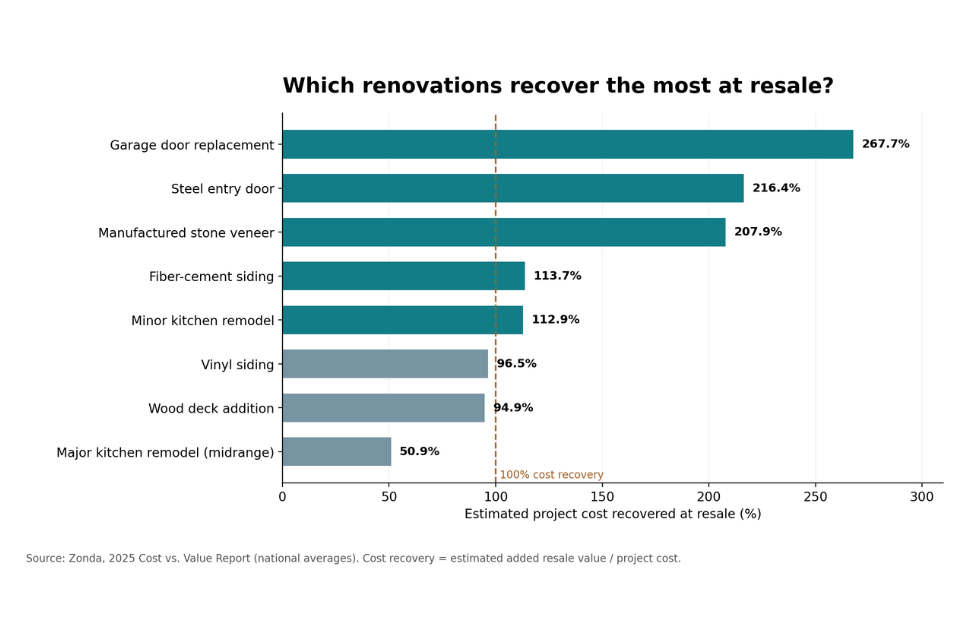
Buyers may value an updated kitchen, but they are not necessarily willing to pay enough to cover expensive appliances, customized cabinetry, or luxury finishes.
The National Association of Realtors’ 2025 Remodeling Impact Report reached a similar conclusion. It estimated that a complete kitchen renovation recovered 60% of its cost, while a bathroom renovation recovered 50%.
Although the studies use different methodologies and project definitions, both show that spending more does not guarantee a proportionately larger increase in resale value.
Does Adding Living Space Increase Home Value?
Adding square footage may seem like a straightforward way to increase property value, but the return depends on construction costs and local buyer preferences.
According to NAR, converting a basement into living space recovered an estimated 71% of its cost, while an attic conversion recovered 67%.
The financial benefit varies by neighborhood. Adding a second bathroom to a three-bedroom home with only one bathroom may contribute more to market value than adding a fourth bathroom to a property that already has three. Similarly, converting a garage into living space may increase usable square footage but eliminate parking that buyers value.
What matters is how much the improvement increases the property’s value relative to comparable homes, not simply how much additional space is created.
Can Borrowing for Renovations Reduce Home Equity?
Consider a homeowner with a property worth $500,000 and an outstanding mortgage balance of $300,000. The homeowner has $200,000 in equity.
Suppose the homeowner borrows $50,000 through a HELOC for renovations that increase the property’s market value by $30,000. The home is now worth $530,000, but the combined mortgage and HELOC balance has increased to $350,000. Consequently, the homeowner’s equity has declined from $200,000 to $180,000. The renovation increased the property’s value by $30,000 but reduced the homeowner’s equity by $20,000.
And this excludes financing costs. At a hypothetical HELOC rate of 7.5%, a $50,000 outstanding balance would generate approximately $3,750 in annual interest, assuming the rate and balance remain unchanged. Over several years, interest expenses can further reduce the financial benefit.
This does not necessarily make the renovation a poor decision. Improvements can enhance comfort and functionality. However, homeowners should distinguish between spending that improves their quality of life and investments expected to generate a financial return.
Why Do Renovation Returns Vary Across Housing Markets?
National remodeling studies provide useful benchmarks, but they cannot determine how much a particular improvement will increase an individual property’s value. Housing markets differ in construction costs, home prices, buyer preferences, and the characteristics of existing homes.
A $40,000 kitchen renovation may bring an outdated property closer to neighborhood standards in one market. In another, it may be more expensive than buyers are willing to pay for.
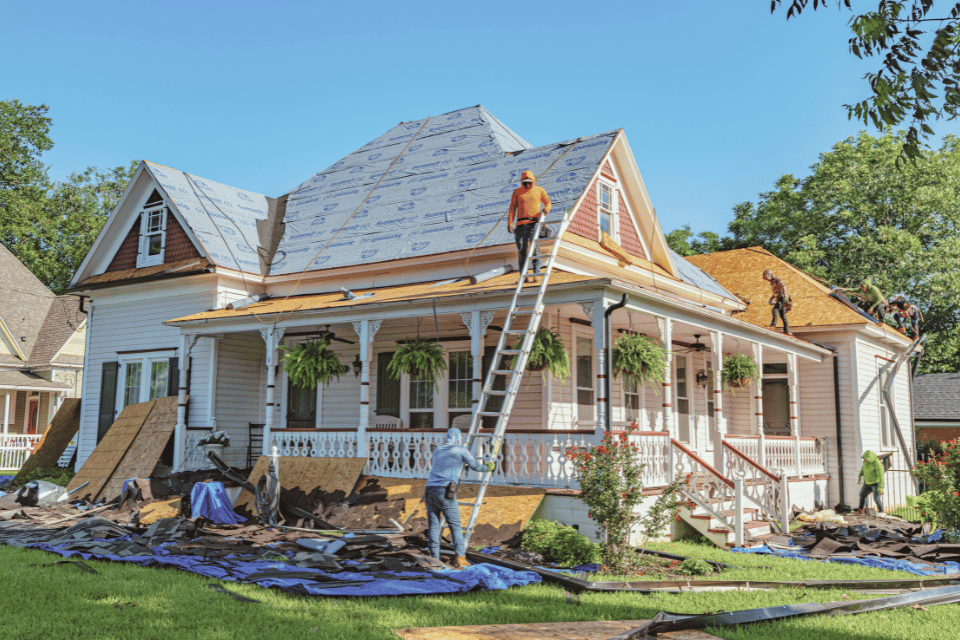
The property’s condition also matters. Replacing a deteriorating roof may not generate a substantial price premium, but failing to replace it could discourage buyers or reduce their offers. Such improvements may preserve existing value rather than create additional value.
There is also a distinction between resale value and appraised value. Remodeling studies estimate what improvements may contribute at resale, while a lender’s appraisal considers property characteristics and comparable market transactions. An expensive renovation does not automatically produce an equivalent increase in appraised value.
Is It Worth Using Home Equity to Finance Improvements?
For homeowners with low mortgage rates, renovating may be more economical than moving. However, the decision to borrow against home equity should be evaluated separately from the decision to renovate.
The 2025 remodeling studies suggest that relatively modest improvements can deliver stronger estimated returns than major renovations. Financing costs can further reduce those returns, particularly when homeowners borrow more than the value their improvements create.
Home equity loans and HELOCs also carry repayment obligations secured by the property. Failure to make payments can put the home at risk.
Before borrowing, homeowners should consider whether the improvements address meaningful deficiencies, how they compare with similar properties in the neighborhood, and how much additional market value they are likely to create.
For those planning to remain in their homes for many years, the personal benefits may justify the expense even when the renovation does not fully recover its cost. But homeowners primarily concerned with preserving or increasing equity need to consider the financial return.